Once you have undertaken all your observations, you can use eLIPS to gain an indication of whether the child’s observed language is in the expected range for their age, not quite at age level or showing some delay. You gain feedback for the three different areas – Doing, Understanding and Saying – to help you identify where the child might need extra support.
The process for obtaining this feedback involves a calculation. After taking your observations, summary scores for each sheet are used to create a total score for each of the three areas – Doing, Understanding and Saying. This is an example of the table to be completed in the eLIPS booklet:
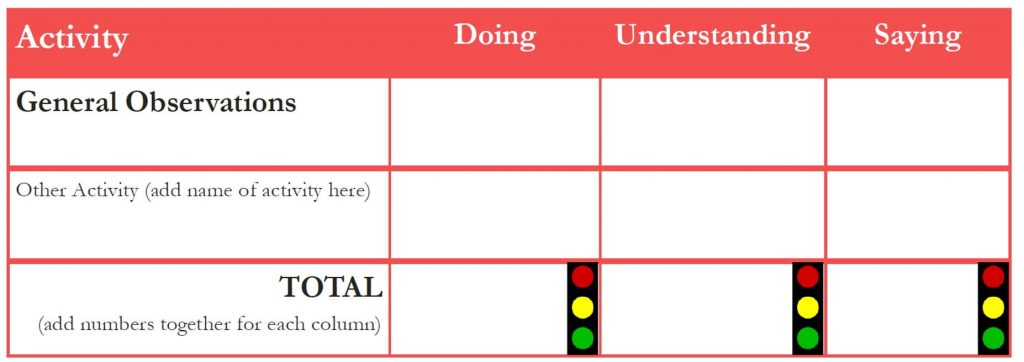
The School Administration team will enter these totals into Progress Sequential and will feedback to you with a RAG analysis of the scores. This compares the child’s scores to other children of the same age and indicates whether the child is facing challenges in their language development, is at risk of doing so or is progressing as expected for their age.
Bear in mind that eLIPS is designed to be used as a screening tool. It is not suitable for diagnosing speech and language or behaviour problems. If you are concerned about a child’s progress after making your observations using eLIPS then a more detailed follow-up assessment may be required.
eLIPS itself is helpful for supporting the next steps for the child in their individual language journey and it’s possible to use the scales to think about ways in which you can help the child to extend their language skills. Discussion with colleagues about eLIPS observations is an important part of this process.