eLIPS is a screening tool to help you make and record observations about a child’s language development. eLIPS is designed to be inclusive of every child in an early years setting aged 2 and above, including children with English as an additional language (EAL) and additional support needs (ASN). However, it is important for you to know the children you observe well, so we would suggest a settling-in time of approximately 6 weeks before you start eLIPS.
How does eLIPS work?
eLIPS is a tool to support your observations of an individual child. These observations will be undertaken during your usual routine and eLIPS provides guidance on what to look for. There are two sections to complete for every child – a General Observations part plus ONE other activity part.
| General Observations: | fill this in for EVERY child |
| ONE other activity: | choose ONE other activity from the four options (i.e. House or Sand & Water or Snack or Outdoors), depending on what the child enjoys doing in the setting. |
Each section asks for observations about what the child is Doing, Understanding and Saying. To help with your observations, there is a statement with a list of possible observations for every part.
- The list gives examples of what you might see in a younger child in the first part of the scale and what you might see in an older child towards the end of the scale.
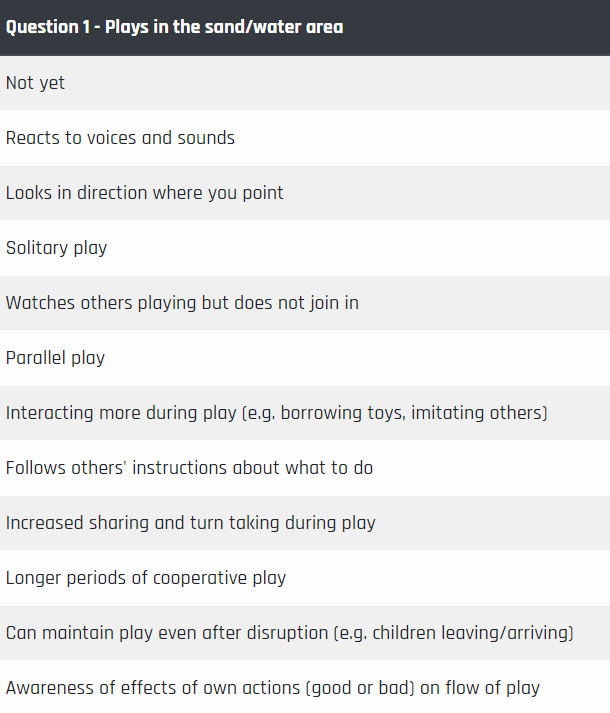
- Record your selection for each statement provided. The statement in the example below is “Plays in the sand/water area”. When you observe the child playing with sand and/or water, we would like you to consider:
“Where would you securely place the child (securely means the child shows this ability repeatedly)?”
- Next check that the child is not yet secure on the next statement on the scale.
It is better to undertake new observations rather than relying on memory because the child may have progressed since the last time you saw them. Also, the child may generally seem very confident and have high abilities in many areas, but your observations might reveal that this is one skill they are still developing.
This is an example of an eLIPS scale:
If you are not sure about which answer to choose, continue to observe the child to find more information. You can also discuss your observations with colleagues to ask them for advice if you find a question tricky to answer.
Don’t be worried about “getting it wrong”. One answer only has a small impact on the overall score. eLIPS consists of a number of different observations to build a general overview of the child. If you are struggling, please talk to someone who also knows the child.
Here is a short video to further explain how eLIPS works:
Example: Video “At the drawing table” – Scale SAYING
Start by reading through the scale below. The scale is describing children’s expressive language, what they can say. Here, we are looking at some features of language developing in childhood.
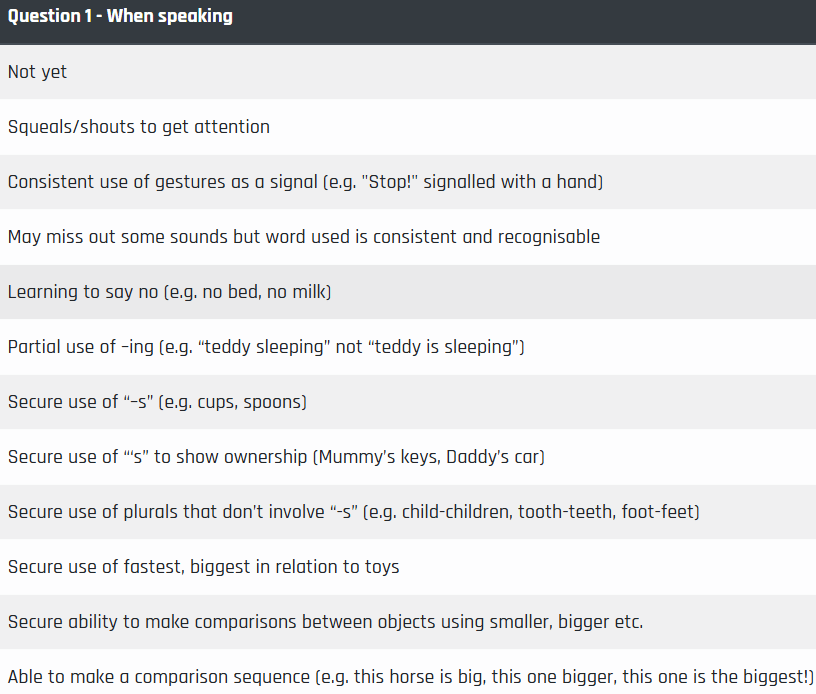
Now watch the following video and consider the girl on the left – looking at the scale above, what have you observed in the short example?
What do you think? Have you identified that in the short clip, the girl used “-ing” when describing her actions? She said: “I was tapping the pen, let me show you, tapping the pen”. This would come under “Partial use of –ing (e.g. “teddy sleeping” not “teddy is sleeping”)”. It is observations like these you would note down to complete your eLIPS scales.
Here is another example:
Example: Video “Child brushing the floor” – Scale DOING
Start again by reading through the scale below. The scale is describing children’s engagement with others, from non-verbal contact making to abstract conversations.
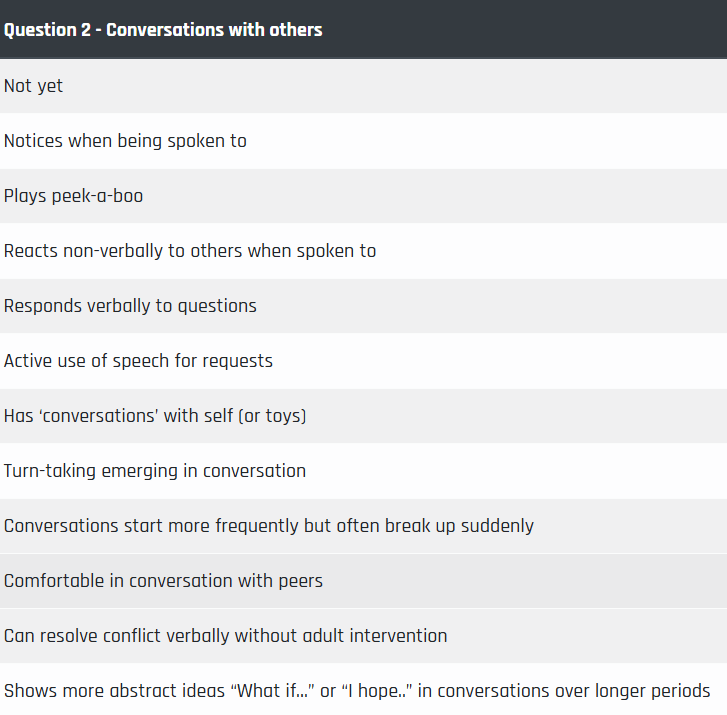
Now watch the following video. What can you observe in the short example?
What do you think? The girl was difficult to understand first, especially to an unfamiliar listener and considering the background noise. As there was no response after the first time the girl spoke, she repeated what she was saying twice, making sure she would be understood. We can now identify the instruction “clean up”, which is further emphasised by being handed the broom. Looking back at the example scale of eLIPS there is one very good fit, which is “Active use of speech for requests”. There may be more, but we would need to continue observations and engage directly to see how a conversation would develop.
For both examples above, you would continue your observations to see if there is also evidence of the next item on the scale. If not, we would suggest that you have identified the child’s current development.
Next we will look at some more examples for you to try, please click here.