The following part will provide you with:
- practice examples highlighting different situations and how to implement eLIPS there
- for early years practitioners: reflection questions to complete for your CPD
Example: Lunchtime – Scale Understanding – Statement “Understands instructions & social rules”
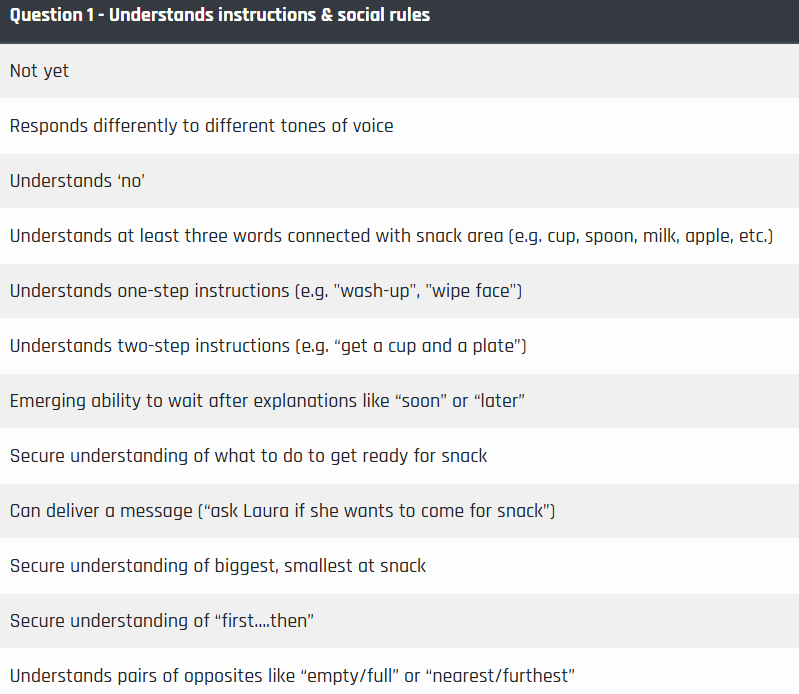
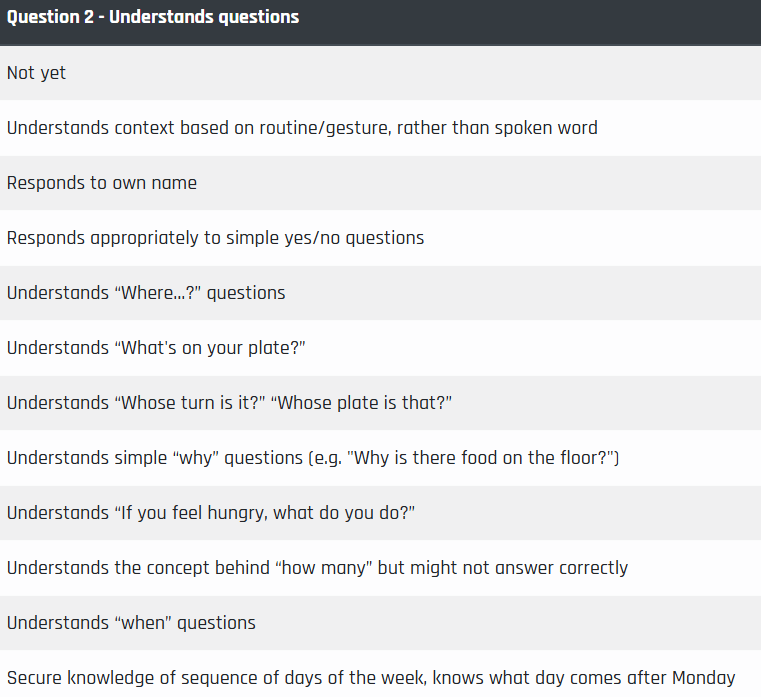
Please read the following eLIPS scale, which details a range of potential observations under the statement “Understands instructions & social rules”. Then watch the video below and consider what you might have observed regarding the young girl Harper’s understanding at lunchtime.
Now watch the following video and consider the girl on the right, Harper.
What have you observed in the video, considering the scale above?
- Harper is focusing on her meal. She is engaging with the observer at the beginning, who asks about her beans. Harper is pointing to her plate, it is not clear whether she indicates the beans or lunch in general. There is a slight indication that she responds when the practitioner highlights that the beans might be finished now. There is certainly an immediate reaction, when the practitioner asks her to use her fork for the potatoes, indicating that Harper “Understands at least three words connected with snack area” and also “Understands two-step instructions”. Using her fork for her potatoes are two separate steps: the fork needs to be picked up (instead of the spoon) and then used on the potatoes.
- We don’t see anything further in this short clip, but it allows us to identify “Understands two-step instructions” as current point for further observations. There is no need to explore anything below this point, but a need to undertake further observations to explore Harper’s ability to understand instructions and social rules fully.
What would you do next in practice?
Have a look at the current scale to see if this helps to further support your observations. There may be an opportunity to explore Harper’s “Emerging ability to wait after explanations like ‘soon’ or ‘later'” on the same day, to identify whether you have reached the ceiling level of this scale describing Harper’s understanding currently.
The same video clip also allows you to note an observation for another scale:
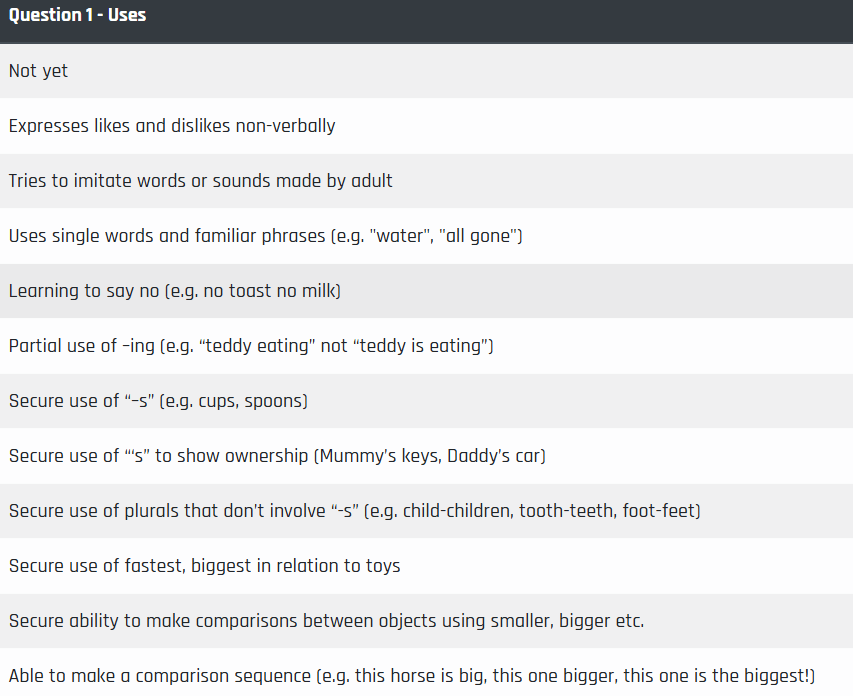
Example II: Lunchtime – Scale Saying – Statement “Uses”
You might want to watch the full clip again to confirm what you think. The second half is posted below to highlight an observation.
What have you observed in the video, considering the scale above?
- There is a very clear indication that Harper “Expresses likes and dislikes non-verbally”, especially when the other girl tried to wipe Harper’s hands.
- There were further sounds to hear from Harper, but not clear enough evidence of whether she tried “to imitate words or sounds made by adult”. Again, this would allow us a starting point for further observations.
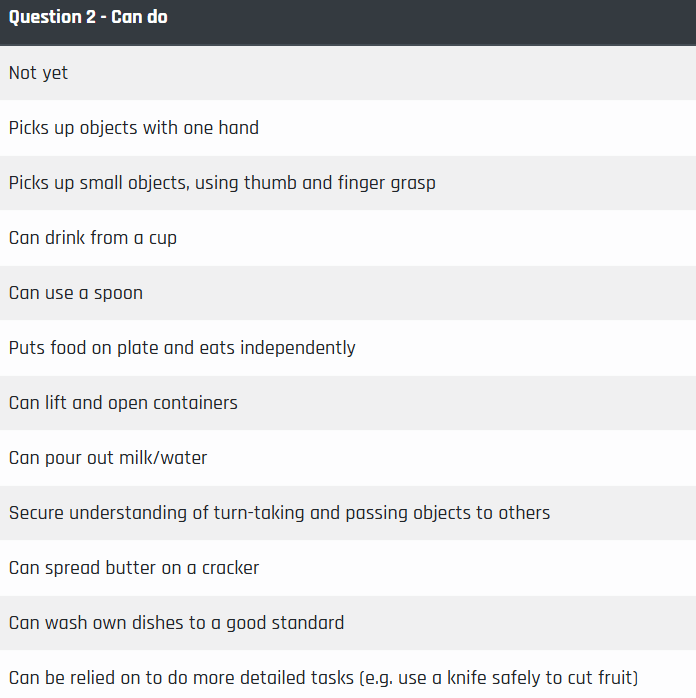
- When you explore the remaining scales under “Snack”, you will see that there could be a note taken for every single scale, based on this short video.
Below is another example, this time observing children playing outdoors.
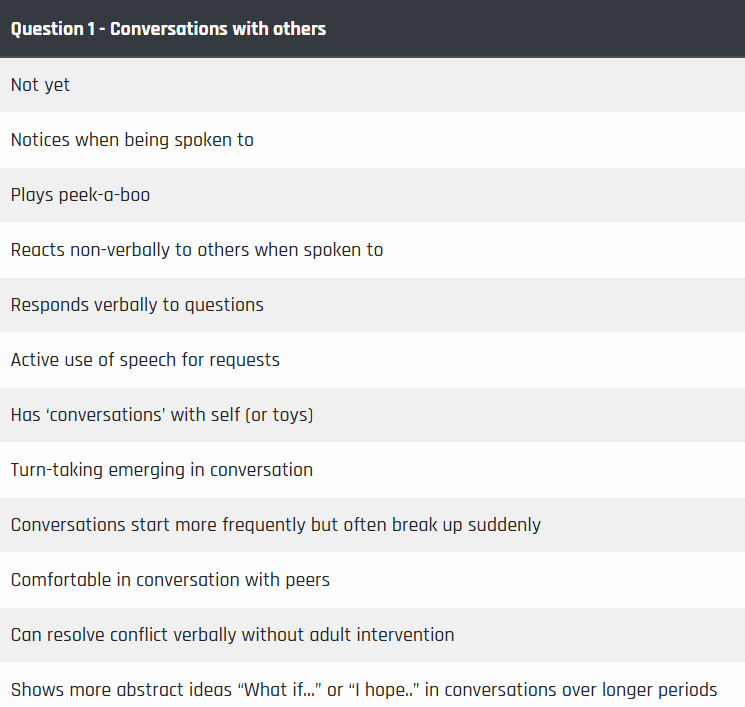
Example: Outdoors – Scale Saying – Statement “Communicates”
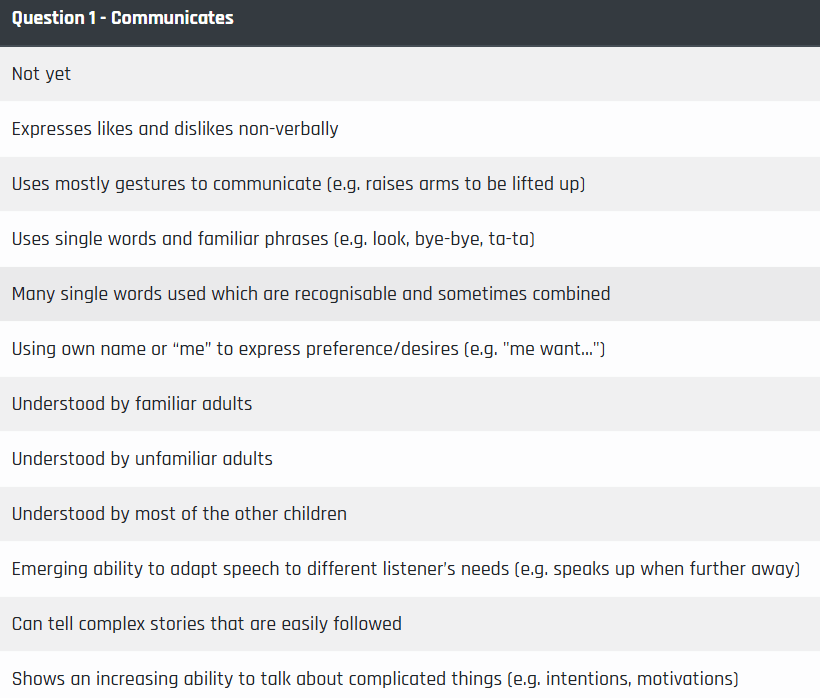
Please read the following eLIPS scale, which details a range of potential observations under the statement “Communicates”. Then watch the video below and consider the boy starting on the right, speaking to the observer.
Now watch the following video and consider the boy starting on the right, speaking to the observer.
What have you observed in the video, considering the scale above?
- There are a few recognisable words, especially “clean” , “It’s all clean”. But the final sentence is much more difficult to understand. From this we could securely consider “Uses single words and familiar phrases”. Being in the situation, there would be further opportunity to explore whether there are “Many single words used which are recognisable and sometimes combined”.
The next video also points higher on the scale:
What have you observed in the video, considering the scale above?
- Once the familiar adult has pointed out “Are you playing car wash?”, it is easier to understand that the boy is most likely saying he is “doing a car wash”. After watching the video a few times, it becomes quite clear.
- This means that the boy seems to be understood by familiar adults. Unfamiliar adults can understand some of his words, but not sufficient to mark this point as secure.
Reflection on your learning
After completing the series of examples, focusing on eLIPS and using eLIPS in more complex situations, we would like you to:
- Reflect: How prepared do you feel trying eLIPS in practice now? Is there anything that you feel unsure about?
- Act: Take a few notes to document your reflection. Can you think of a child where the observations with eLIPS would help you to identify current language development?
- Link: What are your next steps? When can you start trying eLIPS in practice?
The following pages will help with some specific training for using eLIPS with two year olds (click here) and some Frequently Asked Questions, including further links for your development (click here).
Early years practitioners in Scotland: Consider documenting your learning not only for your own records but also to build the evidence of your professional development for your SSSC registration. We would suggest that eLIPS training can be reflected on under Knowledge for my role: Curriculum, assessment, and planning.