eLIPS training: Examples to practice the eLIPS scales
The following part will provide you with:
- further practice examples
- for early years practitioners: reflection questions to complete for your CPD
Example: Conversations – Scale SAYING – Statement “Has conversations”
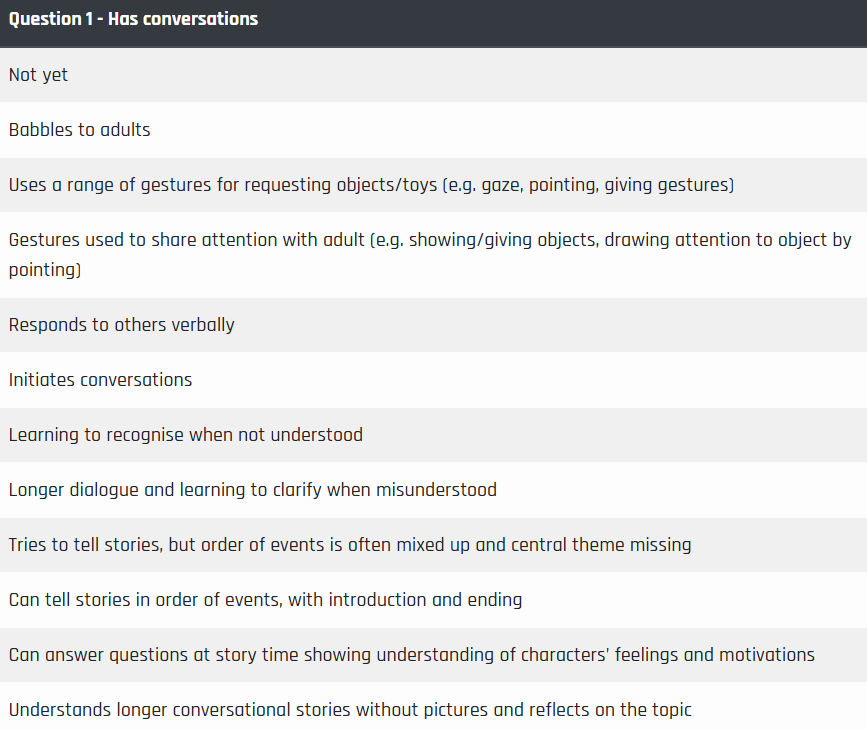
Please read the following eLIPS scale, which details a range of potential observations under the statement “Has conversations”. Then watch the video below and consider the conversation.
Now watch the video below and consider what you might have observed regarding the girl in the blue dress having a conversation with the observer.
What have you observed in the video, considering the scale above?
- We would suggest there was clear evidence that the girl is learning to recognise when she is not being understood. When she points to the other child playing in the house corner and the observer misunderstands what she is saying, she laughs out loud and corrects the observer, stating she meant “the cookie game!” This would be evidence for “Learning to recognise when not understood”. But it could also be evidence for “Longer dialogue and learning to clarify when misunderstood”. What would you suggest?
- When we continue the observation, we come across another misunderstanding about the unicorn juice. When the observer asks to clarify “Your unicorn..?”, the girl simply continues with “Yes, and to see…”. Then she introduces a story about musical statues. In our short video we have two misunderstandings, one fully corrected, one not. To ensure we are confident to have identified the right statement, we would continue the observations. “Learning to clarify” does not mean there has to be a sensible clarification every time, but we want to be sure that the child recognises fully when she is misunderstood and makes regular attempts at clarification.
- Considering the full scale, we might also suggest that there was evidence for “Tries to tell stories, but order of events is often mixed up and central theme missing”. We probably agree that the next step is not yet reached (“Can tell stories in order of events, with introduction and ending”). There have been multiple stories, about her room, the other child’s play and finally musical statues. There didn’t seem to be a central theme and topics did seem to change rather quickly, which would point towards “Tries to tell stories, but order of events is often mixed up and central theme missing “. In the situation, knowing the child well, you would be able to tell if this is a typical occurrence for the girl we are observing.
Here is another example to consider:
Example: Sand & Water – Scale DOING – Statement “Conversations with others”
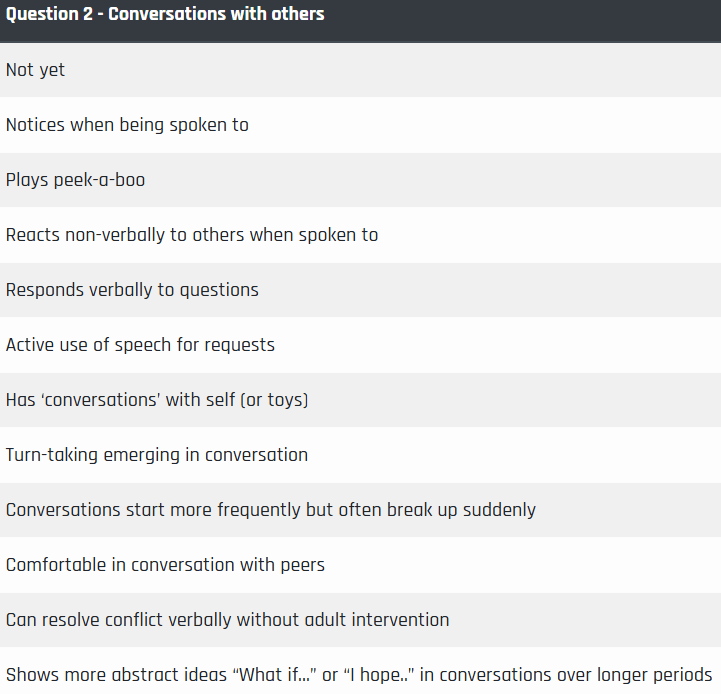
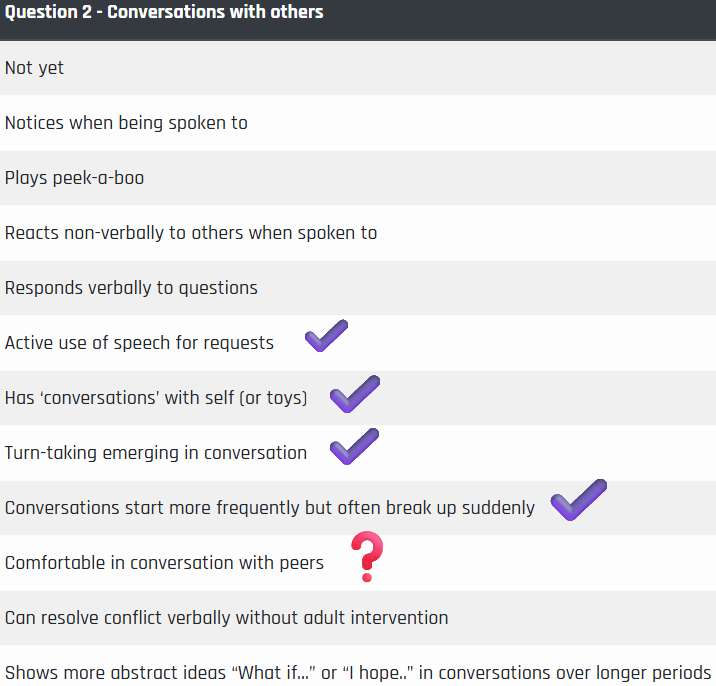
Please read the following eLIPS scale, which details a range of potential observations under the statement “Conversations with others”. This time we have provided a number of videos showing several children engaging in sand and water play. We would like you to focus on the girl in the middle. Please try to identify the observational content you might record from each video to build your evidence for this scale.
Now watch the following video and focus on the girl in the middle.
What have you observed in the video, considering the scale above?
- This example shows the girl actively engaging and directing the play situation. She uses speech actively for requests and seems to have conversations – but as the boy to her right does not respond verbally, we have little evidence for repeated turn-taking.
- The girl’s conversations are directed at the other child rather than herself, but there is definitely a strong attempt at a conversation. We would suggest to record this observation and note that we haven’t seen strong evidence of turn-taking, as we haven’t seen the girl react to someone else’s response. We need to continue observing.
Watch the next clip to see what more you can discover.
What have you observed in the video, considering the scale above?
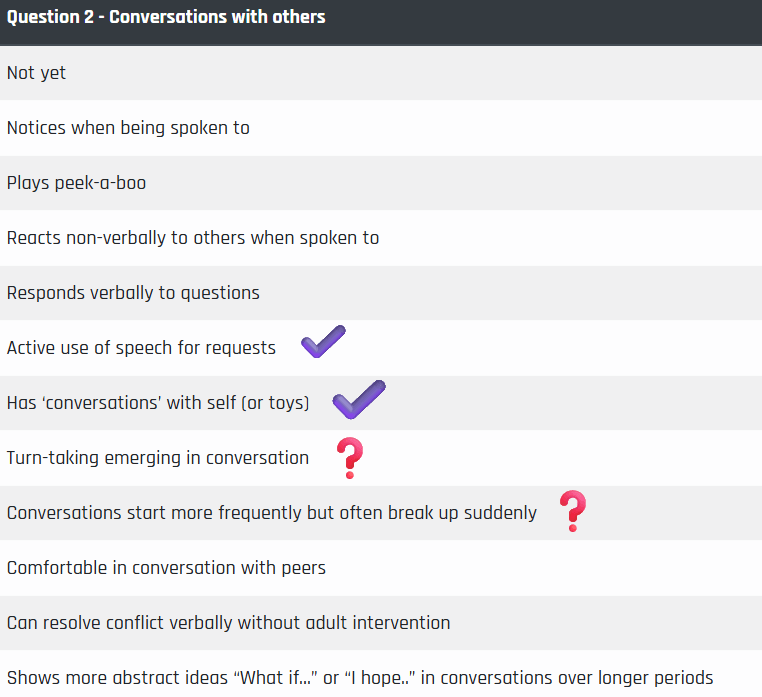
- In this clip we see some turn-taking, the girl addresses her play partner again and he responds, saying that he will get some more water, to which the girl comments “OK”. She then addresses the new child, Sam, who joined the play, telling him to look at her garden. The splashing covers her in water, which she also comments on. Then the flow of conversations is slightly interrupted, as some sand is thrown at her.
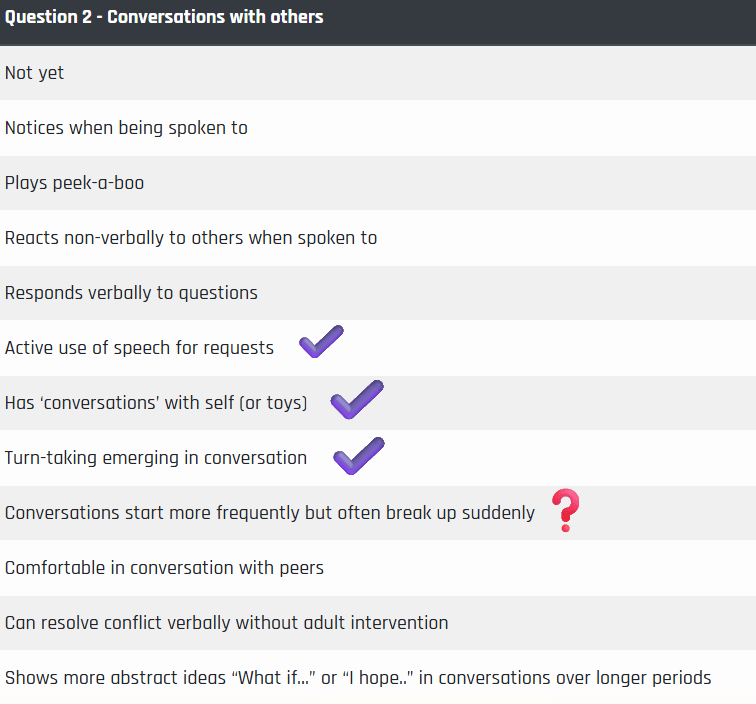
- We have now seen some “turn-taking emerging in conversation” and will continue to seek confirmation for “Conversations start more frequently, but often break up suddenly”.
Watch the final clip to to add further detail.
What have you observed in the video, considering the scale above?
- At the beginning of the video, the girl looks over her shoulder to seek her play partner. She eagerly accepts the water he brings back, but is then slightly distracted by someone else she sees – maybe an adult checking in to see what they are doing?
- But she quickly remembers what she was doing and switches from declaring “water time” for the benefit of the observer to shouting out about the treasure she just found “Look what I have found – A treasure!”.
- Over the three videos, the girl has spoken a fair amount. She gave instructions, tried to catch other children’s and adult’s attention and also responded briefly when spoken to. Conversations did start up frequently and often stopped or re-started again, which would show sufficient evidence for this part of the scale.
- None of the conversations were particularly long and there was not sufficient evidence to see whether she was comfortable in conversations with her peers – she seemed comfortable in company. But that’s not what this scale is looking for.
The example of observing the girl shows that more than one observation of an individual child is needed to complete their eLIPS profile. As you will know the child well, you will have much more awareness of their individual development already when you start completing eLIPS. You are also there in the moment, so will have more evidence to draw on than a series of short video clips.
Reflection on your learning so far
Before moving on, we would like you to take a little break and:
- Reflect: Consider what you have explored about using eLIPS to observe children’s language development so far. How challenging was it to complete the exercises above? Is there anything that you feel unsure about?
- Act: Take a few notes to document your reflection. What questions regarding using eLIPS in practice with the children you are familiar with have come up in your mind?
- Link: How would you go about transferring this knowledge into your practice? Are there any barriers you have identified? Have a look at the following examples to outline some more complex situations, click here.
Early years practitioners in Scotland: Consider documenting your learning not only for your own records but also to build the evidence of your professional development for your SSSC registration. We would suggest that eLIPS training can be reflected on under Knowledge for my role: Curriculum, assessment, and planning.