The following part will provide you with:
- Background information about the development and use of eLIPS with 2-year olds
- Practice examples
- For early years practitioners: Reflection questions to complete for your CPD
Why are we starting to use eLIPS with 2-year-olds?
With an increasing number of younger children starting in early years settings, we are also presented with a wider variety of language skills in children. It is important to understand where the child is in their development holistically. eLIPS can help by providing a focused look at expressive and receptive language and also social communication. Even observing non-verbal children with eLIPS will provide valuable information about where the child is at and what may come next.
How does eLIPS work for 2-year-olds?
We have now further developed the lower end of the scale and tested this in practice. Some of your colleagues have helped refining the steps of the scale an provided feedback on differences of using eLIPS with younger children. This page provides some additional training, which you should complete after you have undertaken the first part of training on the previous pages.
Important for you to know:
- The new updated eLIPS tool can be used with all children, from the age of 2, until they go to Primary school.
- eLIPS is used in the exact same way: you observe the child and take notes. You try to identify your observation on the eLIPS scales provided. You continue your observations until you are sure the child can’t master the next step on the scale yet.
Based on your colleagues’ feedback, what challenges we would expect?
- There are larger difference between individual children of the same age.
- There are fewer interactions between children at this age.
- There may be large differences in your observations between different scales on eLIPS, for example between Doing – Understanding – Saying. This may also happen for observations between the two scales you are using for an individual part.
This is not concerning. Development is fast at this age and differences may be due to a quick spurt. But development is also not continuous across different areas. So, you might observe two areas which show quite a difference at the moment developmentally. Some observations may take longer until you are confident that you know all you need to place the child. Take your time to get to know the child and feel free to interact for your observations.
We would ask that you:
- Take your time to get to know the child. With the younger age group, it is even more important that you are familiar with the individual child’s likes and dislikes, their speech and their facial expression to interpret what they are trying to communicate.
- Don’t rely only on the lower end of the scale, some 2 year-olds may well be able to provide you with observations further along.
- Make sure you do use current observations to find the appropriate space on eLIPS to start with. You do not need to check everything below, but you need to keep going until you are confident you have reached the extent of what the child can currently do.
- Take your time, observe again another day and feel free to change the context, for example from Sand and Water to where the child is currently comfortably playing.
- Discuss your thoughts with colleagues who know the child, especially when you are unsure.
Here are three video examples for you to practice eLIPS with younger children:
Example 1: Child playing in the sand and water area – Scale Doing – Statement “Plays in the sand/water area”
Start by reading through the scale below. The scale is describing some stages of play you might observe in the sand and water area.
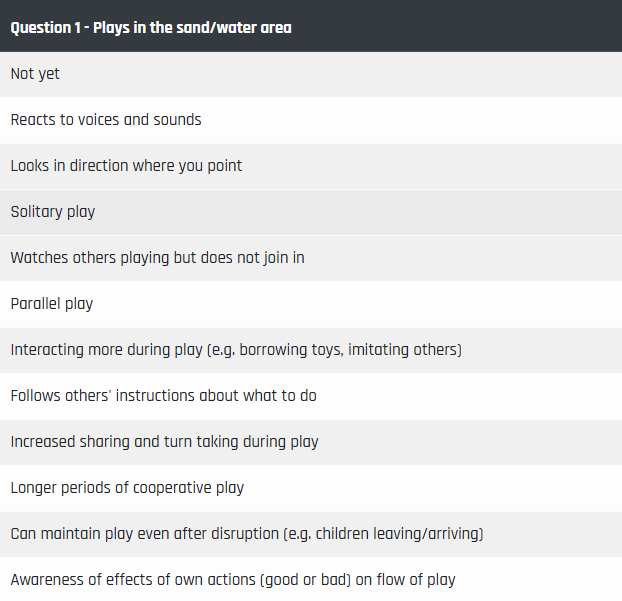
Now watch the following video and consider the little boy in the white top. You can stop and rewatch the video as often as you like. Decide which of the statements above you were able to observe in the video.
What do you think?
- In the first part, the boy on the right is playing alongside the second child showing evidence of Parallel Play, without interacting. There is a significant amount of turn taking with the practitioner, but not with other children.
- In the second part we also see a refusal to allow the other child join in. This observation does not offer us evidence of further interactions, like borrowing, imitating, or sharing. We need to continue the observations to identify if we are confident that he interacts more during play.
Example 2: Children playing outside – Scale Saying – Statement “Has conversations”
Start by reading through the scale below. The scale is describing some stages of conversations you might observe in many different situation. These are not specific to the outdoors and could be observed anywhere.
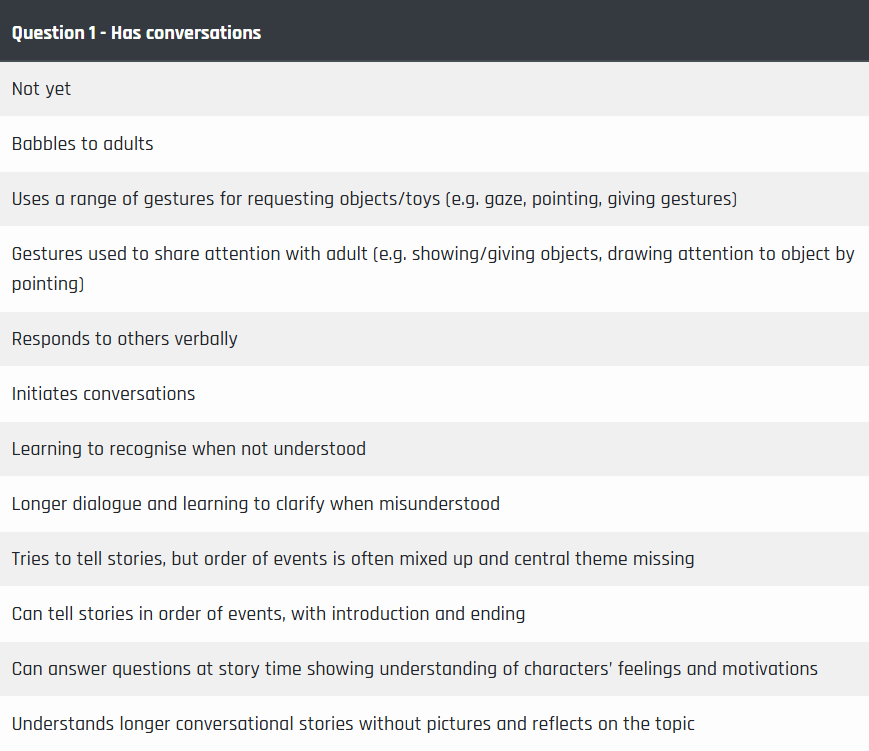
Now watch the following video and consider the little girl spotting an aeroplane. You can stop and rewatch the video as often as you like. Decide which of the statements above you were able to observe in the video.
What do you think?
- Looking at the lower end of the scale, we can see clear evidence repeated pointing, accompanied by excitedly shouting “Look”, aiming to draw others attention to the aeroplane. There is turn-taking and further attempts to continue the conversation, initiated by the girl, when she asks “Where is it going?” We have probably seen enough to be confident that she is able and keen to initiate conversations with others, adults and peers.
- She is repeating herself a few times, which could be seen as some evidence of “Learning to recognise when not understood”. But there is not enough evidence to be confident here. We would need to continue the observations.
Example 3: Children painting with water – Scale Understanding – Statement “Understands instructions & social rules”
Start by reading through the scale below. The scale describes understanding in a range of different situations that might be observed outdoors. But remember, you could use the scale in a different environment if needed, as observing 2 year olds can be more complex and eLIPS can adapt to that.
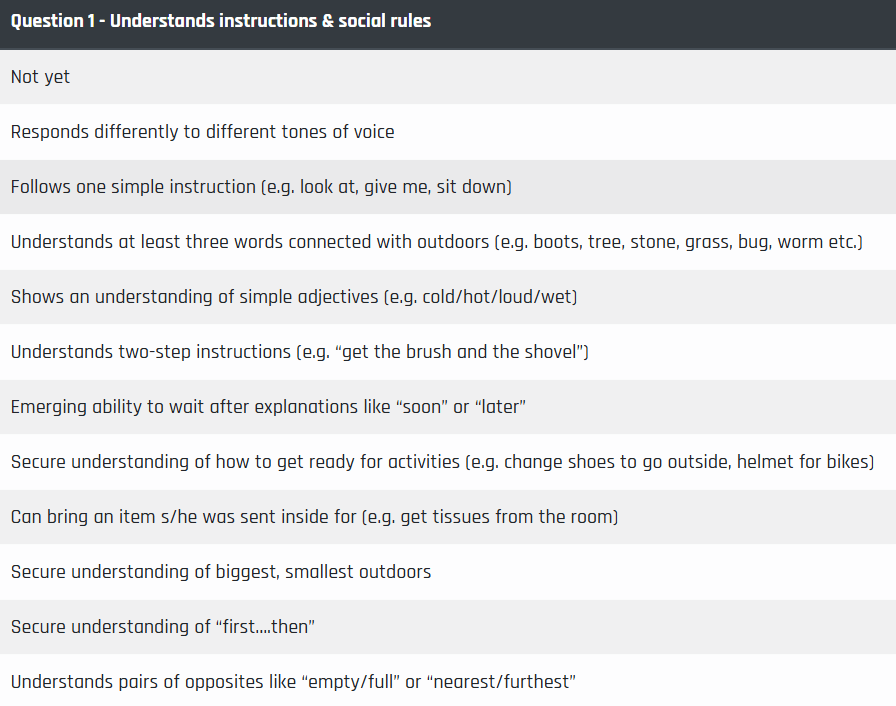
Now watch the following video and consider the child on the left in the red hoodie. You can stop and rewatch the video as often as you like. Decide which of the statements above you were able to observe in the video.
What do you think?
- The child is able to follow the simple instruction to get the bucket. It takes a little while for him to do so, which is an excellent example of the need to give children time to process and respond.
- We can also be confident that he understands two distinct nouns associated with the situation outside: “bucket” and “water”. It is likely that there may be more, but we need to continue the observation to be confident. The following interaction the practitioner would have had while filling the bucket, would have provided opportunities to look for further words the child understands and also to explore the understanding of adjectives further along on the scale. This observation only provided good evidence of “Follows one simple instruction”.
Reflection on your learning
After completing the this part of examples, focusing on using eLIPS with younger children, we would like you to:
- Reflect: How prepared do you feel trying eLIPS with 2 year olds in your setting now? Is there anything that you feel unsure about?
- Act: Take a few notes to document your reflection. Think of a child where the observations with eLIPS would be helpful to identify current language development. What questions might you be able to answer through the guided eLIPS observations?
- Link: What are your next steps? When can you start trying eLIPS in practice?
The following pages will help with Frequently Asked Questions and also provide further links for your development (click here).
Early years practitioners in Scotland: Consider documenting your learning not only for your own records but also to build the evidence of your professional development for your SSSC registration. We would suggest that eLIPS training can be reflected on under Knowledge for my role: Curriculum, assessment, and planning.